Grant McCracken, in his book “Culture and Consumption”, recalls an essay by French philosopher Francis Diderot. In his essay, “On Partying with my Old Dressing Gown”, Diderot described the transformation caused in his life by a beautiful new dressing gown he received as a gift. He loved the gift, but soon thereafter however, he notices that, compared to the new gown, the decoration in his room, the rug, the curtains, the desk, all looked shabby. He proceeds to replace them one by one, so that they match the new gown. McCracken describes this process as the “Diderot effect”, the way people create a lifestyle by trying to find cultural consistency in the things they buy, so that they “match”.
I just mention this idea because I came across the new Nissan Pino, recently launched (last January) in Japan, targeted at young women. Looking it as it is, it seems like just another small car. However, a visit to Pino’s website quickly tells a different story. To start with, you're welcomed by this "lovely loading" sign.
 Then you get it. Pino is a kawaii (cute) car. But the interesting thing about the Pino is not the car in itself, but how the cuteness meaning is created. Look at the picture below.
 The car is not the center of the action. It’s more of a complement to the whole scene. And it’s the surrounding, with all its cuteness, that "contaminates" the car with meaning. Normally, as Wired’s Mark Durhan well noted, “...using cutesey fluffy pinkness to sell cars to 20-year-old women would be beyond the pale - too narrow, too sexist, too ludicrous. Not so in Japan”.
The Pino, much as Diderot’s gown, helps the girls define a lifestyle. Like Diderot’s gown, it’s not the only item, but a complementary object that, along with her keitai (mobile), her favorite pair of jeans, her pair of sneakers, her handbag, her nail polisher, and all her other possessions (all “lovely” of course, see below), creates her lifestyle and will accompany her “365 days a year, 24 hours a day”. And then comes the fun part, accessories. Girls can choose a heart-shaped cushion, a stuffed dog called “Pino Dog”, a flower-patterned upholstery, and a dozen other matching items, to help them create the desired effect.
 Accessorizing and personalization are not new ideas, but I hardly remember seeing them so tightly-knit behind the creation of specific lifestyles.
And if you thought the concept of “cuteness” defined only one lifestyle, you haven’t really started in this world. Pino’s campaign shows a group of three fashionable friends who strut around their different "cute styles".  They portray three different types of cuteness: the “feminine cute” Yumi-chan, who is a model and loves dancing and snowboarding;...
 ...the “casual cute” Kimi-chan who wears a pair of jeans shorts and practices yoga;...
 ...and the “beautiful cute” Tamami-chan, who wears a plaid skirt and is into classic ballet.
  Each one of them brings her own matching accessories; a stuffed pink dog and flower-themed upholstery for Yumi-chan; an apple-shaped CD holder and a green dog for Kimi-chan, and so on. One does not have to worry about which is the best match. Pino does it for her (but of course, people are free to try their own creativity).
I don't know if this "cute strategy" would translate well outside Japan, maybe this is too much of a Japanese thing, but the concept behind it is great. Diderot would've certainly endorsed it.
Monday, April 02, 2007
diderot and the cute nissan pino

Wednesday, March 28, 2007
google acquires trendalyzer
Just a note following-up on the theme of my latest post.
Google's recent acquisition of Gapminder's Trendalyzer software only highlights the importance of data visualization. Gapminder co-founder, Hans Rosling, of course, is well known for his 2006 TED presentation where he showed how data can be presented in a more clear and visually arresting way (and he's becoming famous for being a sword swallower as well!).
Google's Marissa Mayer, says that, "like Google, Gapminder strives to make information more useful, and Trendalyzer will improve any function or application in which data might be better visualized...We hope (to make) it freely available to any and all users capable of thinking outside the X and Y axes".
Google has already made available a beta-version, here.  I guess this acquisition makes a strong case for the importance of "information aesthetics" nowadays. As we get overloaded with information, "the problem", as Mr. Rosling aptly said in his TED presentation, "is not ignorance, it is preconceived ideas".
how cool is your name?
Very interesting piece on PingMag about "Infoesthetics: the beauty of data visualization". There are several examples, but the one that caught my attention was this one: The Name Voyager. It's an interactive tool showing the popularity rank of baby names from 1880 to 2005. As you can see below, "Nelson" used to be a popular name... around 1890! The accompanying blog, by Laura Wattenberg, author of "The Baby Name Wizard", offers a fascinating look into baby name trends and pop culture influence.
minority report-esque?
I guess some of you must've seen this already, but I only saw it yesterday. Jeff Han, of NYU, showing his multi-touch user interface. Notice how you move your entire body, much as in some video game that I'm becoming tired of writing about. So, do the iPhone, the Wii (oops), and this demo point out the future of computer user interface? Interesting that Mr. Han says that a 3-D interface would actually be a step backwards, definitely not "Minority Report" then, after all. The official wordless demo below (via Pogue's Post).
Tuesday, March 27, 2007
china's "batteries not included"
There's an old Spielberg-produced movie called "Batteries Not Included" where a group of tenants in an apartment block fights against a real estate developer who wants to throw them out of the building (you can view the trailer on YouTube here).
The end, I won't tell you, but this real-life story taking place in today's China reminded me of that movie (see photo below). The owner of the house refused to move out so the developer dug a giant pit around it. People are calling it the "nail house".
And as I learned from a recent boingboing post, this is not so uncommon at all (and not restricted to China as well). The whole story with more pictures on China Daily (here)
Thursday, March 22, 2007
wii infiltrates the culture

Tuesday, March 20, 2007
time's new design
The latest issue of Time magazine brings a new design developed by Pentagram's Luke Hayman, Time managing editor Richard Stengel and art director Arthur Hochstein. Below is the table of contents page and the Briefing section.
 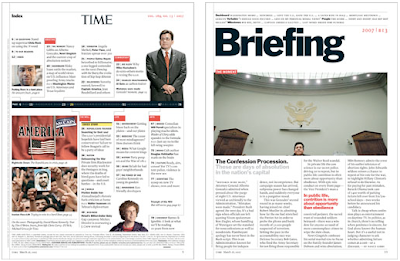 More pages and an overview of the new design project at Pentagram. There's also an interesting note at boingboing about the tear on Reagan's face.
eugene, oregon
I've never been to the city of Eugene, in Oregon.  But a place that: is known as the "Track Capital, USA", holds the Prefontaine Classic every year, has held many Olympic Track Trials, will hold the 2008 Trials as well,...
 ... and has a restaurant called "Track Town Pizza", gotta be a nice place to visit.
Monday, March 19, 2007
bowerman and the men of oregon
 He closed great, calloused hands around my throat. He did not lift me off the ground. He did relieve my feet of much of their burden. He brought my forehead to his. "I'm going to ask you to take part in an experiment," he said with menacing calm. People five yards away thought we were sharing a tidbit of gossip. "For three weeks, you are not going to run a yard except in my sight. You will do a three-mile jog here every morning, and our regular afternoon workouts. If I or any of my spies sees you trotting another step, you will never run for the University of Oregon again."
"Bill..."
"Are we agreed?"
"Bill..."
"Agreed?"As I was feeling faint, I submitted.
And so starts Kenny Moore's recount of the life of famed Oregon track coach Bill Bowerman.
Bowerman is a legend among track fans, having coached the University of Oregon for 24 years, winning the NCAA four times, coaching several Olympians, and being the US Head Coach in the Munich Olympics in 1972.
His most famous athlete was Steve Prefontaine, who died prematurely in a car accident in 1975, and whose life made to the big screen not only in one, but in two movies, "Without Limits" and "Prefontaine". Bowerman's character is played respectively by Donald Suthlerland and R. Lee Ermey in those movies. See "Without Limits" trailer on YouTube here. But Bowerman went on to be much more than a track coach. He went on to shape part of our lifestyle and our culture.
In the early '60s, after witnessing the work of another legendary coach, Arthur Lydiard, in New Zealand, he wrote a booklet about the positive effects of long-distance running for the average person. The book was entitled "Jogging". It went on to sell more than 1 million copies and helped ignite the running boom. He was obsessed with improving the shoes his athletes used for running, and made many experiments in his garage workshop. The story about how he put foam rubber on his wife's waffle iron is already stuff of legend. The "waffle" sole and his association with Phil Knight, another one of his former athletes, gave birth to Nike. He stayed on Nike's Board of Directors until June 1999, a few months before he passed away on Christmas Eve that year. He is held in such stature at Nike that the eleventh of the company's "11 sacred rules" is simply, "Remember the man".
All these fascinating events are narrated by Kenny Moore. Moore, a former University of Oregon athlete himself, running under Bowerman, was one of America's best marathoners, having competed in two Olympics, his best result being a fourth place finish, in Munich, behind teammate Frank Shorter's gold. When his athletic career was over, Moore became one of the best sports writers in America. He was a senior writer for "Sports Illustrated", where he worked for 25 years. He also co-wrote the script for the movie "Without Limits" (he even plays a part in the movie).
Moore therefore writes about Bowerman with the reverence and love of a disciple writing about his master. His firsthand account of the stories, many in which he was an actor himself, such as in the opening paragraph above, gives an invaluable insight into the man behind the legend.
My own copy came with a few initial pages roughly cut (see photo below).  I almost returned the book right away, but then I noticed Phil Knight's foreword was missing. Found out that because of a last-minute legal tangle between Knight and Rodale, Rodale decided to go ahead without Knight's foreword. However the first edition was already printed. Somebody at Rodale must've spent many long hours cutting those pages from the thousands of books already printed. Knight later published his foreword in the May/2006 issue of Playboy magazine. You can read it here. I decided to keep the book. And I don't regret it a bit.
"Bowerman and the Men of Oregon: The Story of Oregon's Legendary Coach and Nike's Co-Founder", available at amazon.com
Friday, March 16, 2007
US$ 100 laptop
This is really cool. A prototype of the $100 laptop from Nicholas Negroponte's One Laptop Per Child project (via How blog).
Thursday, March 15, 2007
apple: america's best retailer
There's a very interesting story about Apple in the latest edition of Fortune magazine. This time about how Apple has transformed itself into America's best retailer, beating the 'sales per square foot a year' of established retailers such as Saks, Best Buy and even Tiffany's (read article here, sub. req.).
According to the article, a research report by Sanford C. Bernstein, shows that the averages of Apple's 174 stores is US$ 4,032 psf/year, against Saks' $362, Best Buy's $ 930, and Tiffany's $ 2,666.
Not so surprising considering the stores' relative small size (compared to other, much bigger department stores) and the number of people who frequent them. See the line outside the Regent St Apple Store, in London, below (2005 Christmas season).
Tuesday, March 13, 2007
nintendo gets it!
 Corporate culture is one of the most important aspects of an organization. For mega corporations with thousands of employees all over the world, that's what holds a company together, their set of values.
There's no amount of micromanaging that can teach how a customer service rep should do his/her job, but tell them what the company values are and somehow they'll figure out what to do.
Take a look at this post from saska, about her surprising experience with Nintendo's customer service.
Now read this article in the "Washington Post" about Nintendo's video game guru Shigeru Miyamoto (photo on the left) keynote speech at last week's "Game Developers Conference", in San Francisco.
Miyamoto, creator of "Mario Brothers" and "Donkey Kong", told the audience, "developers should resist the temptation to create only sequels of established hits and games based only on horror and revenge". Speaking about his own approach he said, "I always want that first reaction to be emotion, to be positive, to give a sense of satisfaction, glee... Certain obstacles may temporarily raise feelings of suspense, competition, even frustration. But we always want that final result, that final emotion, to be a positive one."
If you read both articles, it's clear there's a common thread there, and that's why Nintendo seems poised to take over the gaming world.
Reference:
Konrad, Rachel (2007). Nintendo Guru Wants More Happy Games. The Washington Post. March 8, 2007 (here).
Friday, March 09, 2007
burn calories and save energy
How nobody thought of that before!
Hong Kong's branch of California Fitness, a fitness chain with many gyms across Asia (including Singapore) is testing an innovative concept: their cardio machines, such as stationary bikes, steps, and cross-training, have been equipped so that energy burned off by people doing exercise is transformed into electricity.
The brainchild of inventor Lucien Gambarota, the project is appropriately called "Powered by You". The goal is to make California Fitness more energy efficient, with the capability to produce and store energy. See video on YouTube here. (via inhabitat)
Thursday, March 08, 2007
nike's new basketball uniforms
Nike has unveiled its new college basketball uniforms, to be worn by four college teams, Arizona, Florida, Ohio State, and Syracuse, and which they have named "System of Dress". It is comprised by a tight top (similar to those used by track athletes), and a loose bottom (very, very loose, where do you think they got the 'dress' name from).
The other novelty is that players will be able to customize their uniform to a certain extent, using long or short sleeves tops and Dwayne Wade-style leg wraps.
Nike designer Hans George says that the change was the result of "athlete feedback and cultural insight... the desire among players to personalize their look while still looking part of the team".
It's already producing what some reporters are calling "a dramatic" new look in sports. Take a look below.

ted 2007
The 2007 TED Conference starts in Monterey, California. You can follow some of the action here. And wait for the presentations to be available here, sometime in the future. In the meantime, you can watch Wired Editor-at-Large Kevin Kelly, talking about the evolution of biology and technology (duration: 20:39), on TED 2005, below (or download it here).
Wednesday, March 07, 2007
the diffusion of culture
Zapping through the TV channels in Singapore, I happen to catch a lot of the 'international' channels programming, state-owned TV channels such as Germany's DW-World, Japan's NHK, France's TV5 Monde, and China's CCTV, and I couldn't help but noticing how differently they approach their job.
While they all state their goals as promoting their respective country's culture, through news and entertainment, as well as to provide a more 'balanced' view of the world, the commonalities stop there.
France's TV5 Monde is a channel almost exclusively dedicated to French speakers. The only exceptions are some late night movies sub-titled in English (which are pretty cool by the way). This approach however, definitely limits the number of people they can reach, which makes me think they're not really that interested in promoting their culture as much as they are in promoting their language (sort of, "if you really want to know more about us, learn French first, monsieur").
Japan's NHK does have a few shows for non-Japanese speakers. There's one news program dubbed in English (with a Japanese-speaking anchor and an English-speaking commentator's voice-over), and other newscasts and variety shows in English (with a mix of native and non-native English-speaking anchors). Despite being a little more accessible than TV5, I really would like to see more English-spoken or English-subtitled shows, especially their documentaries and movies. My favorite NHK show is "Cool Japan" (about which I blogged here), and which incidentally is spoken mainly in Japanese (only the guests speak English but it's enough to give a general understanding about the context of the show). See the video below about the Japanese influence on the Paris fashion scene (spoken in Japanese and French, on YouTube here). In contrast with the two channels above, China's CCTV takes a bolder, more ambitious approach, albeit a more expensive one. Instead of mixing their programming grid with Chinese and English-spoken shows, they set up two different channels altogether, CCTV-4, spoken in Chinese, and CCTV-9, spoken mainly in English (there are only a few shows spoken in Chinese, but always with English dubbing or sub-titles). Take a look, for example, at the video below, a show in Beijing last year, celebrating Deng Li Jun, a.k.a. Teresa Teng (on YouTube here).
 And finally, Germany's DW-World stands somewhere in the middle, airing some newscasts and variety shows in English (my favorite is Euromaxx, a variety show about interesting things in Europe. You can view a short segment on Danish designer Arne Jacobsen on YouTube here).
 These differences in strategy show two things: (a) some state-owned channels compromise the diffusion of their country's culture by trying to be too "pure" (dangerous word, but in the lack of a better one), sticking to their own language; (b) the Chinese government is willing to make high investments to promote their culture, trying to leverage their newly acquired economic status. Keep an eye for Chinese brands to follow.
One final note: to be fair, this analysis is based mainly on the nightly programming, so while they reach a prime-time audience, I can't say for sure they represent the entire programming (though I'm almost certain they do).
I do hope these channels take on a more accessible approach to non-speakers of their countries' languages. After all, where else could we have better access to news about Boston's Daisuke Matsuzaka, Houston's Yao Ming, or the latest Jean-Pierre Jeunet movie?
Tuesday, March 06, 2007
china to slow down?
China's Premier Wen Jiabao announced yesterday that China's GDP growth target for 2007 is 8%. That's lower than the staggering 2006 growth of 10.7%!
Speaking at the opening of the National People's Congress, Mr Wen announced that the government's main goals for this year are to achieve harmonious growth, addressing the income gap between urban and rural population, while cutting energy spending and pollution.
China's economic growth is nothing short of extraordinary for a country with such a big population. Goldman Sach's well known BRIC report previews that China will overtake the US as the world's largest economy around 2041. The same report previews that by 2050, China's per capita income will be US$ 31,357.00, which is almost equivalent as the current GDP per capita in Japan! Can you imagine 1 billion-plus people with that much spending power?
Monday, March 05, 2007
water cube
The spectacular "Water Cube", venue of the swimming and diving competitions in the 2008 Beijing Olympics, had its outside membrane structure completed last December.
Of all the new stadiums being built for the Games, I personally find this the most striking one.
Below, a view of the project... ... and the actual building below.
 522 days to go.
association for consumer research
I’ve been an on and off member of the Association for Consumer Research (ACR) since 1993, as far as I can remember. The ACR is an academic association dedicated to promote the study of consumer behavior. Its members come from a wide range of expertise (anthropology, marketing, sociology, communication, linguistics, etc.) and include luminaries such as Harold Kassarjian, Sidney Levy (a pioneer who wrote the seminal “Symbols for Sale” in 1959!), Gerald Zaltman (How Customers Think), and my favorites, Grant McCracken (Culture and Consumption), Russell Belk (Happy Thought), Morris Holbrook (Symbolic Consumer Behavior), and Elizabeth Hirschman (The Creation of Product Symbolism).
Collectively they have published a wealth of knowledge and insights since ACR's inception in 1969. I personally found their production fascinating for somebody whose good chunk of work is to understand consumers (although this is not ACR's main goal, let me be clear, this is an academic body, knowledge for knowledge's sake, they don't exist to provide consulting services).
Nonetheless, they've provided me with invaluable insights about symbolic consumption, ethnography, cultural aspects of consumption, to mention just a few of the topics they cover. In the process, they have explored all sorts of unconventional methods in trying to understand consumers, from introspective, self-analysis of their own consumption behavior, to analysis of movies as consumption objects, to the analysis of the sacred aspects of consumption, which easily make them one the most unconventional, innovative, and creative group of people that I’ve ever met (even if some of the articles are too highbrow for me to understand).
For whatever reason though, I seldom meet a branding practitioner who is aware of the existence of this body of knowledge. Perhaps people get intimidated by the academic approach, but if you get past the academic terms, there are real gems in there.
Take a look at some of the articles below:
"Happy Thought", by Russell Belk.
"I'm Hip: An Autobiographical Account of Some Musical Consumption Experiences", by Morris Holbrook
"Advertising: Meaning or Information", by Grant McCracken
"Consumer Behavior Meets the Nouvelle Femme: Feminist Consumption at the Movies", by Elizabeth Hirschman
Most of these articles can be found either in the "Journal of Consumer Research", or in ACR’s website (there’s an online proceedings search). Enjoy the readings.
Friday, March 02, 2007
did nintendo copy xavix?
Have you heard of a game console called Xavix? I saw it at the store yesterday and, surprised, I thought to myself "hmm, already a Wii copycat"! Then later I checked on google and to my even bigger surprise I learned that Xavix was actually launched on September 2005, a full year before Nintendo's Wii!
Xavix, made by a Japanese company name SSD, basically has the same principle as the Wii, it's an interactive motion controlled gaming console. There are a few differences though:
- The remotes resemble actual sports equipments (boxing gloves, tennis rackets, golf clubs, etc.) thus rendering a more realistic experience (not sure whether this is necessarily better in terms of pure game enjoyment)
- The view on the screen doesn't show your 'avatar'. The ball comes straight at your face in a tennis game, for example.
- Nintendo's marketing is much more focused and clear. Xavix seems uncertain of what it wants to be: a video-game or a fitness device. From their website: "Xavix is a revolutionary way to interact with your TV. From your favorite sports to high-energy workouts..."
Take a look for yourself at xavixstore.
Also check out this commercial on YouTube.
Thursday, March 01, 2007
time out singapore
 Just because I said the other day that magazines are dwindling, we're witnessing a couple of interesting magazine launches recently.
First came Monocle. Now, the launching of Time Out Singapore, with the latest arts and entertainment listings, will give a boost to the city-state's plans to become a cool city.
Singapore now joins the likes of London, New York, Shanghai, Dubai and 13 other cities that have their own "Time Out" edition. This one though is a monthly edition, not weekly as the London one.
Tuesday, February 27, 2007
it's ok to have a messy desk
 "If an untidy desk signals a messy mind, then can we say that a clean desk signals an empty mind?".
I've always subscribed to the above theory but, unfortunately, without hard data, I've been on the losing end of this argument a couple of times.
Well somebody finally came to my rescue. Eric Abrahamson, a business academic, and David Freedman, a journalist, published a book, "A Perfect Mess", showing that to have "moderately" messy desks can lead to more efficient and more creative work. Compiling several cases throughout history to backup their case, they finally show that it's ok to have "moderately" messy desks (that's the caveat and I have yet to see if I qualify in that category) . The most interesting anecdote is the discovery of penicillin, an accident only possible because of the mold created in Sir Alec Fleming's messy desk. Genius!
Read the review in the "The Daily Yomiuri" here.
Monday, February 26, 2007
wii winning the video-game battle
It's still a little early to tell but Nintendo's Wii seems poised to win the battle of the video-game consoles. According to the Financial Times (reg. req.), it "has soared past Microsoft's Xbox 360 in sales and opened a huge lead over Sony's premium-priced rival, the Playstation 3".
Still according to the article, a Merryl Linch analyst predicts that, "by the year 2011, almost a third of the Japanese households, and almost 30 percent of all US households will own a Wii". That's huge! If we take into consideration only the households with children, that percentage would increase considerably.
Wii's success is a great example of non-linear thinking, of winning the battle by playing a whole different game.
On Wii's website, there's a very interesting interview series with the team that created and developed the console. Hosted by Nintendo's president, Mr. Satoru Iwata, it gives a glimpse on the approach the team chose for the project. See this statement from Mr. Takeda, who led the project:
"...if we had followed the existing Roadmaps we would have aimed to make it “faster and flashier.” In other words, we would have tried to improve the speed at which it displays stunning graphics. But we could not help but ask ourselves, “How big an impact would that direction really have on our customers?” During development, we came to realize the sheer inefficiency of this path when we compared the hardships and costs of development against any new experiences that might be had by our customers... After speaking with Nintendo's development partners, I became keenly aware of the fact that there is no end to the desire of those who just want more. Give them one, they ask for two. Give them two, and next time they will ask for five instead of three. Then they want ten, thirty, a hundred, their desire growing exponentially. Giving in to this will lead us nowhere in the end..."
As I said in the beginning, the battle is still in its early stage, so let's see how it develops, but according to Credit Suisse analyst Jay Defibaugh “there has always been a strong concern that the Wii was gimmicky...but each passing month assuages that.”
Reference:
Lewis, Leo (2007). Nintendo's Wii Outsells Rival Consoles. Financial Times. February 21, 2007.
Friday, February 23, 2007
ali rap on espn
 Watched "Ali Rap" on ESPN, a documentary based on the George Lois' book I blogged about the other day. It's a fitting tribute to Ali's verbal punching power, featuring some of his classic moments, as well as some famous guests such as Sylvester Stallone, James Earl Jones, Sidney Poitier, Ludacris, Kareem Abdul-Jabbar, Diane Sawyer, Angelo Dundee, and George Lois.
The documentary has been released on DVD as well, including the entire 1974 Ali vs. Foreman fight in Zaire.
You might be led to think I'm a big boxing fan, which I'm not. Actually I rarely watch boxing matches. Having said that, there are 4 fights that every sports fan should watch: the three Ali vs. Frazier clashes, and of course, Ali vs. Foreman, a master class on how strategy and finesse (if you could say so about a heavyweight boxer) can triumph over brute force.
Thursday, February 22, 2007
innocent breaks into uk's top 100 brands
 A survey by Check Out magazine (reg. req.) in the UK, shows that while traditional brands such as Coca-Cola and Walkers still dominate the top of the grocery list, healthy brands are enjoying the strongest sales growth.
Remarkably, Innocent Drinks, the smoothie brand (love the 'strawberry & banana' one), is the fastest-growing UK brand, and for the first time breaks into the top 100, at No. 63, with sales of £96m.
Reference:
Smithers, Rebecca (2007). Organic Food Breaks Into Top 100 brands. The Guardian. February 21st, 2007. (here, free, but reg. req.)
Top 100 Grocery Brands Report (download it here, free but reg. req.)
Wednesday, February 21, 2007
monocle magazine
 I got my hands on Monocle magazine's premiere issue. Magazines all over the world are dwindling, many are folding (George, Talk, The Face, to name a few), and most are getting slimmer, with fewer and fewer advertising pages. So it is laudable that somebody is willing to launch a new magazine given this scenario.
Monocle was launched positioning itself as a new type of business magazine. Well, it is definitely not a business magazine in the traditional sense. With sections categorized from A to E (Affairs, Business, Culture, Design, Edits), the magazine's premier edition brings an eclectic mix of topics, such as the emergence of Japan's navy (the cover story), an interview with Lego's CEO, the semiotics of Iran's president wardrobe, and a fashion editorial set in Okinawa.
The most interesting piece for me is an article about Miura Golf Clubs, the maker of Tiger Woods' clubs (Nike puts the logo on them, but they're actually made by Miura). Hint: following on centuries of samurai sword forging tradition they see themselves as forging specialists, not club makers, which gives an idea about the craftsmanship involved.
Some other features of the magazine:
- At 242 pages it is surprisingly big
- There's a "manga" supplement, complete with instructions on how to read it (from right to left, obviously)
- It clearly intends to be an international edition. With a head office in London, the magazine has bureaux in New York, Zurich and Tokyo.
shrewd marketing or spam?
The Chicago Cubs has agreed on a deal with sports apparel maker Under Armour to have ads placed on its legendary ivy-covered walls. The Cubs' Wrigley Park is one of the most traditional ballparks in what is arguably America's most traditional sport. Already some purists are protesting this move. Reference:
Sullivan, Paul. Cubs Show Tradition The Door With Ad Deal. Chicago Tribune. February 14, 2007. (see here)
Sunday, February 18, 2007
zapcode in singapore
I got the heads up about this from ag407's Fernando Barros (thanks Fernando), who told me about shotcode, a technology that resembles a barcode. Unlike the traditional barcode however, this technology allows mobile phone users to access more detailed information about a product, for example. Basically the code contains a link to a website, which people can access only by taking a picture of it. The applications are endless. It can be used to provide more information about products, events, movies, etc.
Now Singapore's SPH, publisher of The Straits Times, has launched a similar product called ZapCode. 
Thursday, February 15, 2007

Wednesday, February 14, 2007
where ideas come from
Who would've thought? YouTube creators were inspired by HOTorNOT.com. According to an article in Time magazine (Dec. 16, 2006, the "Person of the Year" issue), "Chad and Steve agree that Karim deserves credit for the early idea that became, in Steve's words, "the original goal that we were working toward in the very beginning": a video version of HOTorNOT.com."
about the future of gaming, computers
Some interesting bits on the blogsphere, dealing with trends in the computing and gaming industry. Somehow they're all interconnected, though I can't quite explain now.
- Steve Johnson muses about the Nintendo Wii (amazing how the Wii is bringing long lost consumers to the category)
- Momus writes about the age of the ubiquitous computing (and mentions the Tokyo Ubiquitous Network Project)
- Mark Cuban discusses the future of computing and gaming, and the implications for Microsoft, Apple, Google, Sony, etc.
Monday, February 12, 2007
ninja restaurants
Following up on my 'ninjas are cool' post, found out that there are ninja-themed restaurants in Tokyo and New York. The restaurants are designed like a ninja castle, complete with trap doors, hidden passages, shuriken-printed napkins, and of course, ninja-waiters. They even have a 'torture chamber'. When the cook or the waiter messes up with your order, the other ninja-waiters tie him up and give him a good beating, 'ninja style' (lucky him, in the old ninja days, a ninja who made a mistake was not supposed to come home alive!). Too funny!
Check out this video on YouTube.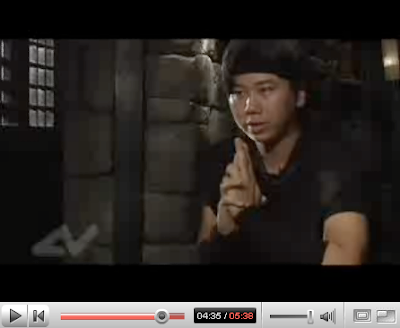 (via tokyomango, thanks Lisa)
PS: oh, and the food looks great too!
Thursday, February 08, 2007
ali rap
Read 'Ali Rap', a book edited and beautifully designed by George Lois, and published by Taschen and ESPN. Actually I flipped through it in less than one hour, so fascinating the book is. But more than just a book about Ali's famous wisecracks and rhymes, which are geniuses by themselves, the book takes the reader to a journey through America's recent history. And all that designed by George Lois. It doesn't get any better than this. Some excerpts from the book:
"This is the legend of Muhammad Ali,
The greatest fighter that ever will be.
He talks a great deal and brags, indeed,
Of a powerful punch and blinding speed.
Ali's got a left, Ali's got a right,
If he hits you once, you're asleep for the night."
"I'm so fast that last night I turned the light switch off in my bedroom... and I was in bed before the room was dark."
On a return to a young, terminally ill cancer patient:
Ali: "I told you I was gonna whup George Foreman. Well, I'm back from Zaire and I did whup George Foreman, and now you're gonna whup cancer".
Boy: "No, Muhammad. I'm going to meet God. And I'm going to tell Him I know you."
Wednesday, February 07, 2007
beijing olympics pictograms


 In the official website you get to see the evolution of the design since the 1964 Tokyo Olympics.
Tuesday, February 06, 2007
the oscars
Watched a couple of videos from Dreamgirls and they just blew me away. Jennifer Hudson and Beyonce Knowles singing, just watching the trailer gives me chills. Make yourself a favor, find your way to the clip below (in the movie's web site, in Media & Video/Clips) and watch Beyonce singing 'Listen'. A full video in YouTube. About Jennifer Hudson, what a terrific story, 'only in America' kind. She's been compared to Aretha Franklin. Watch this interview with Today Show's Matt Lauer.
 'Half Nelson'. With a title like that I've got to watch it.
My sentimental favorite for Best Movie: 'Little Miss Sunshine'.
On an ad industry note, you've probably seen Wieden & Kennedy's Honda Civic 'Choir' commercial. According to W&K's blog, "Steve Sidwell, composer of the soundtrack and conductor of the choir in the ad, has been commissioned to compose and conduct a soundtrack for a choir to sing live at the Academy Awards emulating vintage motion picture feedback". Pretty cool.
marketing + technology
Couple of technology enhanced marketing moves in Japan:
The first is this interactive projection advertising technology by a company called Catchyoo (via CScout). I saw a similar technology being used at some museums in London but this is the first time that I've seen it being used in advertising. It can be projected on floors, on walls, on tables, etc. In many ways, it feels like a video game, and the Wii comes to mind. See video here. The other example is this virtual make-up booth, a joint project developed by Mitsukoshi, Shiseido and Fujitsu.
I'm no make-up expert, but I guess most women will be pleased to be able to try as many variations as they like without going through the mess of having to apply the make-up, then having to wipe it off, then applying another option and so on. Eventually they'll still want to try out the real stuff, but at least they can make a previous selection.
The machine scans the woman's face and through an LCD screen, she can try as many variations as she wants to (by waving products with RFID tags on a tag reader). The screen shows how she'll look, and better yet, she'll be able to see the before/after effect. The project runs through Feb. 12th at the Mitsukoshi store in Ginza (via Wired Blog).
Friday, February 02, 2007
design conscious singaporeans
There's an interesting ongoing campaign in Singapore called "10 Touchpoints. Better Living. Better Design", promoted by the Design Singapore Council, which urges Singaporeans to vote for the worst designed everyday items in the island. At the end of the campaign, the top-10 most voted items are going to be redesigned.
That's an interesting way to raise awareness about the importance of design in everyday life. We all have complaints about mundane things that we believe could be better designed and yet, most of the times, we don't bother to voice our opinions. Well, here's our chance. Nominations can be made until Feb. 14. Votes can be cast until Feb. 27.
So far, some of the most voted items are:
Ugly drains and canals, poorly designed bus handle, lack of an island-wide cycling lane (this one really deserves a vote), better "keep left" signs on the subway escalator (that's really interesting, this being a former British colony. In London you're supposed to stay on your right). Visit the campaign's website and see more examples (and cast your vote).
Thursday, February 01, 2007
shrewd marketing or spam?
Couple of moves worth commenting:
- The Chicago White Sox home games are going to start at exactly 7:11pm. Not 7:10 nor 7:12. That's because the convenience store chain 7-eleven has agreed on a US$ 500,000 a year sponsorship through 2009. Viewers are now going to be asked to tune in at exactly 7-eleven, or rather at 7:11pm, by TV announcers. See the team's press release here.
- More recently and still in sports sponsorship, State Farm, an insurance company, closed a deal to put its logo on more than 40 college basketball courts across the US. Aside from the usual sideline boards, they'll now have their logo on the back of backboards, affixed to the support arm. - Starbucks is being targeted by an online campaign that aims to have the coffee chain's Forbidden City store in Beijing closed. See the story in The Guardian, here (reg. required). Check out this flickr page as well for more pictures.
Reference:
Elliot, Stuart (2007). State Farm Is There, Right by the Backboard. The New York Times. January 31, 2007. (see here)
Watts, Jonathan (2007). Starbucks Faces Eviction From the Forbidden City. The Guardian. January 18, 2007.
 Subscribe to this blog's feed

