I'm going to take a couple of weeks off. I should resume blogging some time in January.
I just wanted to say thanks and wish you all Merry Christmas.
See you in the New Year.
Nelson
P.S.: I wanted to leave something cheerful, and found this pearl of wisdom from Fernando Sabino, a Brazilian author:
"No fim dá certo. Se não deu, é porque não chegou ao fim".
Roughly translating it goes something like this:
"It'll end up well. If it didn't, it's because it hasn't ended yet". (can anybody offer an alternative translation?)
Friday, December 22, 2006
happy holidays

Wednesday, December 20, 2006
meaning of home 2
Just a couple of examples, following up on the previous post.
Indeed these different meanings of 'home', depending on the culture, help explain the many variances in the way people live, from architectural design to family habits. In Asia it's common to remove one's shoes before entering anyone's home, a clear evidence of the separation between the pure ambiance of the home and the polluted outside world. Most homes and apartments have small shoe cabinets just outside the main entrance, such as this one, being sold in a Singaporean expat website. Another evidence of the clear boundary between "clean" and "dirty" areas is this picture (via Jan Chipchase), of a mountain lodge in Japan.
 These shoes are specifically for use in the men's toilette. The rest of the building is shoe-free.
I suspect these different meanings account for many other manifestations, such as the use of chopsticks, instead of knife and fork (seem as "weapons of aggression"). And Feng Shui, obviously, could only have been invented in Asia (in China, more specifically).
Tuesday, December 19, 2006
the meaning of home
I've been interested in texts about 'home' recently (part of a broader interest in memoirs and migration), and came across this interesting quote by Genevieve Bell, anthropologist and Director of User Experience at Intel, in Fast Company's latest issue:
"...We have slow-moving cultural paradigms, and 'home' means something in our imaginations. In England and America, you say, 'My home is my castle.' In India, people talk metaphorically about their homes as 'pure' and the outside world as 'polluted.' In Indonesia, home means grace, modesty, and simplicity."
Reference:
Deutchman, Alan. Fast Talk: Home Improvement. Intel's Genevieve Bell on why our homes will never be like George Jetson's. Fast Company. December 2006/January 2007.
where do ideas come from?
From an interview with Italian architect Renzo Piano (of Paris' Centre Georges Pompidou fame, which he designed with Richard Rogers), in Metropolis magazine:
When you visit buildings by other architects, what do you look for?
Haha! First, I enjoy them very much. Second, I steal everything. Stealing is maybe too hard a word. There’s an Italian word, you say “rubarro,” which means a nice robber, without a mask.
What did T.S. Elliot say, “Good poets borrow, great poets steal”?
It’s really about that. But art is about that. Music is about taking and giving back. In a way I spend my entire life stealing from everything—from the past, from cities I love, from where I grew up—grabbing things, taking not only from architecture but from Italy, art, writing, poetry, music. And you know what, I put all my robberies in a little piece of paper that I have with me and fill almost a whole sketch pad. Even when I don’t like a building, I still find something to take. This is probably because I was never a good school boy, so I grew up with the idea that I was not the first in class and I was a problem all the time. When you grow up with that idea, you spend your life taking from others.
Monday, December 18, 2006
michelin gps
 Have you ever unknowingly driven through a major landmark or a nice restaurant only to find out about it when you return back home from your trip? Well, it happened to me a couple of times and I can tell you I was not exactly happy about it (you usually become aware of it only when a somewhat amused friend says "don't tell me you didn't go there!").Now Michelin, the European map and guide company, has launched a GPS that contains information from their guides and maps. Currently it's available only in Europe and in the US. The European version lists 51,000 establishments (29,000 restaurants and 27,000 hotels). Plus it has a feature called POI (Point of Interest) Alert. They claim to put "the pleasure back into driving". I think what it does is bring more context and meanings to our trips. As we drive, suddenly the GPS flashes, "One-star Michelin restaurant 2 km ahead". No more missed opportunities!
Reference:
Biggs, John. Electronic Navigation With the Michelin Touch. The New York Times. December 14, 2006. (here)
Saturday, December 16, 2006
little miss sunshine
 I'm a little late on this, but finally watched "Little Miss Sunshine" on the plane from Singapore to London.
I guess you’ve all read the excellent reviews this movie has been receiving, and they're well deserved.
This is a sweet, or should I say, bittersweet movie, a poignant human comedy about the Hoovers, a dysfunctional family traveling from Arizona to California in an old VW bus, trying to make it to the "Little Miss Sunshine", a pre-pubescent beauty pageant contest, the dream of Olive, the seven-year-old daughter.
The cast is excellent. Greg Kinnear plays a (not so successful) motivational speaker who splits the world between "winners" and "losers", and who desperately tries not to fall in the latter category; Alan Arkin is the foul-mouthed, cocaine snorting grandpa (who proves to be an anarchist and a prophetic sage in the end); Paul Dano is the rebellious teenage son who made a vow of silence and hasn’t spoken in nine months; Steve Carell, excellent as the depressive, suicidal uncle, the number one Proust scholar in the world, who brings a bit of much needed perspective to the whole absurdity of the situations; Toni Collette, as the exasperated mother who tries to hold the family together; and the unforgettable girl, the sweet Abigail Breslin, all innocence and wonder, who like most girls of her age, dreams of being a beauty queen.
But despite the reviews praising it as being a road movie with soul, I think they slightly missed one important underlying theme.
This is as much a road movie as it is a movie about raising kids in our days. In many moments, the directors (Jonathan Dayton and Valerie Farris) invite us to think about the difficult dilemmas we face in raising a child nowadays.
What is “right”, and what is “wrong”? Is there "right" and "wrong"?
Do we let them find out for themselves some of the world’s ugly truths or do we protect them?
Do we nurture their dreams, impossible as they might be, or do we give them a dose of reality?
Do we impose our preconceived ideas of how things should be or do we let them rewrite the rules?
There's a scene when Olive, in a moment of self-doubt, hesitantly asks, "grandpa, am I pretty?”. At that very moment, when she asks a question probably every woman asks when growing up, she reminds us how susceptible children are to our actions. For an adult it's just a nod, or a glance of disapproval here, maybe a sarcastic comment there, but for a child they can mean a world of difference, the difference between a confident, bubbling child, and an insecure one.
The movie’s end (I won't spoil it for you) reminded me Sir Ken Robinson presentation at TED. He said about children: "if they don't know, they'll have a go". As parents, I guess, this is all we can hope for. That they will have a go.
Thursday, December 14, 2006
ag_407
I went to meet Alex and his gang from ag_407, André, Fernando and Selma. They handed me a copy of the "Invitro Yellow Pages" (looks great, congrats guys) and we chatted for some time. Such nice people. Later, Alex and Fernando took me for a delicious lunch at Pitanga (their specialty is typical Brazilian food).
The photo below was the "icing on the cake", a modern version of a traditional Brazilian dessert called "Romeo and Juliet". It's a cheese mousse swimming in guava syrup. Pure heaven.
Thanks Alex for picking up the bill.
Tuesday, December 12, 2006
wii at the science museum
The Science Museum in London has a great exhibition exploring the history, technology and culture of computer games. You can play some of the classic games of all time, like Pongo, Super Mario, and PacMan, among many others.
The highlight of the exhibition is a special Wii and Playstation zone. We went there last Thursday and tried the Wii. We played tennis and it was a blast, really fun. Just one warning: although you don't get to run like in a real tennis match, it's advisable to warm-up at least your upper-body because the arm movement is pretty much what you would do in the real thing. If you don't do this, you'll feel your arms sore the following day (as I did).
Wednesday, December 06, 2006
long trip
We're traveling to Sao Paulo for the holidays, with a short stop in London. It's a long, long trip (twelve hours from Singapore to London, and another twelve from London to Sao Paulo), so I'll probably won't be posting anything for the next few days.
invitro yellow pages
The good people at ag_407 published an internet guide, the "Invitro Yellow Pages", where some of the coolest people in Sao Paulo share their list of top web sites and blogs. They were kind enough to include me in the book (I guess that makes me the only exception among some really cool people). Thanks guys, can't wait to get my hands on my copy.
Tuesday, December 05, 2006
foot reflexology
Spotted in Singapore. Bus advertising for Kinohimitsu Health Pads. At first look, I thought it was a mattress ad (although usually there are only two people in these mattresses ads). Then I got closer and saw the pads on the feet (you can barely see the light blue squares). The foot reflexology industry is big in Asia. In Singapore there are many foot reflexology parlors.
cell phone, mobile, or keitai?
Mobile culture is one of the topics I'm most interested in nowadays.
Recently, I came across Mimi Ito's blog (I believe it was via Jan Chipchase's blog, but I'm not sure, just way too many feeds). She has edited the book "Personal, Portable, Pedestrian: Mobile Phones in Japanese Life", about the meaning of the mobile (cell) phones in Japan, from where the excerpt below was taken:
"In contrast to the cellular phone of the United States (defined by technical infrastructure), and the mobile of the United Kingdom (defined by the untethering from fixed location), the Japanese term keitai (roughly translated, ‘‘something you carry with you’’) references a somewhat different set of dimensions. A keitai is not so much about a new technical capability or freedom of motion but about a snug and intimate technosocial tethering, a personal device supporting communications that are a constant, lightweight, and mundane presence in everyday life."
I just thought it was striking that the Japanese have actually chosen a Japanese word to define their mobile handset. They have one of the most permeable cultures, at least when it comes to naming new objects and habits, happily adopting the English name, or a modified form of the English version (sarariman for "salary man", pasucom for "personal computer", chiketto for ticket, and so on).
But keitai, or "something you carry with you", really brings the mobile (or cell phone) to a higher level of intimacy and presence. It practically becomes an extension of the body, which might help explain the ubiquitous, almost symbiotic relationship the Japanese have with their mobile phones.
Monday, December 04, 2006
quarter pounder, r.i.p.
 It happened to me some time ago. I was in a sort of a rush and had to grab something fast to eat. I went to a McDonald's and ordered a Quarter Pounder and a Diet Coke (the Diet just to ease my guilt). The lady taking my order looked blankly at me and replied: We're not serving Quarter Pounder anymore.
It took some time to sink in. I couldn't hide my surprise.
I'm sorry, what do you mean, is it temporary?
No, the lady replied again, the Quarter Pounder was discontinued.
I couldn't believe it.
You're saying you have discontinued one of your most iconic products? The Quarter Pounder, the "Quarteirao" as the Brazilians say it, or the "Royale with Cheese", star of one of the most memorable dialogues in cinema's history (in my book), and you have discontinued it? (I didn't say all this, but that's what crossed my mind).
The Quarter Pounder fell victim to the new, healthier McDonald's (in Singapore at least).
As culture changes, products and brands will change as well. Some new ones will be launched while others will be "discontinued". They have a Grilled Chicken Foldover now (by the way, what do they call it in Paris?).
Frustrated, I ordered a Double Cheeseburger instead, just to satisfy my crave.
Quarter Pounder, R.I.P..
Friday, December 01, 2006
wii have a problem
Some early Wii users are already reporting having troubles with the console. No, it's not a bug. It happens when they swing too fast (playing bowling, for example), and accidentally let the remote slip from their hands. What's the result? A smashed TV screen, and a broken remote (apparently the remote strap is not that strong). (via Yahoo!News)
I wonder though, is it really an 'accident' or does the interaction with the game feel so real they actually release the remote believing they've just released the ball?
On the other hand, and I guess this ends the discussion, The Onion made a "feature by feature" comparison between the Wii and the PS3, in which the Wii definitely comes on top (via Michell).
Me? I'm 'totally' leaning towards the Wii (despite the broken TVs). I'll just make sure I don't buy the bowling game and will try to get a stronger strap somehow. 
Thursday, November 30, 2006
smoking is a marketing problem
I'll say this once and then I'll shut up. Smoking is as much a marketing problem as it is a public health problem. Therefore, the people coordinating anti-smoking campaigns should be marketing professionals, not Public Health officials.
According to a recent New York Times' editorial, a research published in the American Journal of Public Health shows that "exposure to tobacco company youth-targeted smoking prevention advertising generally had no beneficial outcomes for youths". Well, this shouldn't be a total surprise, since this is more of a PR move by the industry, trying to prevent further backlash from the society.
But I see other anti-smoking campaigns and I can't help getting the feeling that this is an incredibly one-sided battle. While one side has mastered how to pull all the culturally relevant strings directed at the youth (to start with, think Bogart and Bacall, James Dean, Brando) and keeps pushing the coolness envelope with persuasive, cutting edge marketing messages (branded content, sports sponsorships, and many other activities), the other side insists in promoting the health problems caused by smoking (often using gruesome images attached to the packaging).
I don't have any data on my hand, so I may be wrong, but I think this approach is highly ineffective. It only reaches smokers who already want to quit, and it doesn't really prevent youngsters from falling to the temptation of trying smoking just a couple of times. By the time they're hooked, it's too late.
If Public Health officials are serious about fighting the tobacco industry then they should hire marketing people with deep knowledge of human motivation, meaning management, consumption rituals, and myth creation, to manage their anti-smoking campaings. And if they are really serious, they should rally other countries' governments to join them in a global, cooperative, communication effort (after all, aren't the "enemies" global as well?).
But it'll never happen, so I'll just shut up.
Reference:
Editorial. When Don't Smoke Means Do. The New York Times. November 27, 2006. (here)
where do ideas come from?
As the end of the year draws near, it's now time to join your co-workers for company parties. Some will risk going to a karaoke (we've all been there, haven't we?).
And it occurred to me that the karaoke is nothing more than a modern version of the old Max Fleischer cartoons with the "famous bouncing ball", which invited us to sing along. I used to watch these cartoons as a kid, and remember sitting in front of the TV absolutely enthralled by that bouncing ball. Here's Popeye singing his theme song (here). From Popeye and the bouncing ball, we went to this. Enjoy it (and I bet you'll sing along).
Wednesday, November 29, 2006
brands and pop culture
Two examples of brands that are trying to engage pop culture:
The first one actually is a co-branded effort between Nerf's Showtime Hoops and AND1. Showtime Hoops is a basketball kit that promises to bring the excitement of streetball right into your living room. It has an attached sound system that says when you hit a good shot and when you didn't, all emceed by AND1's Duke Tango. AND1 has been a phenomenon. Riding the wave of NBA's success but trailing an entire different path, the brand has built its reputation as the street, hip-hop version of the (then) clean-cut NBA. They stand for a lifestyle now, selling shoes, DVDs, video-games, magazines, etc. See the TV commercial here.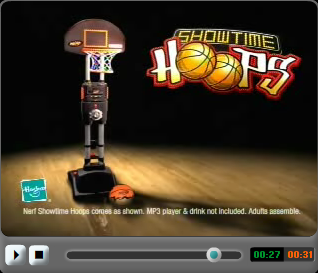 The other example is Burger King's launching of three X-Box games featuring "the creepy king from the US commercials" (via uncrate.com). You can buy one at US$ 3.99 with the purchase of a Value Meal.
Tuesday, November 28, 2006
i hate (brand name)
 When you become a celebrity, some people will like you, but some will not.
There's an interesting article in the New York Times Magazine about this celebrity fate, showing the case of the "Rachel Ray Sucks Community".
Rachel Ray is not well known in Asia, but she's big in the US. She's a television food celebrity. She has her own TV show, her own magazine, has written many cooking books, and recently started her own talk-show. But what sets her apart is her ebullient character. According to Grant McCracken, "stylistically, Rachael Ray is the anti-Martha...Where Martha Stewart was cool, authoritative, self possessed, as if from the manor born, Rachael Ray is warm, improvisational, unassuming, and just folks. If Martha Stewart was ceremonial perfection to home making, Rachael Ray captures the "close enough is good enough" spirit that animates most American households."
Grant obviously thinks highly about Ray's approach, arguing that she's rescuing the rituals and meanings involved in food preparation and consumption, something that has been largely forgotten recently by TV food shows, with much of their focus being only on the food preparation (and not on what happens after the food is cooked). I've never watched her show but I tend to listen to what Grant says.
So, I was a little surprised that the number of Ray haters (how do you call them?) was so large. According to the NYT's article, the group has more than 1,000 members, whose common trait is to be "anti-Rachel". They criticize "...her cooking skills, her overreliance on chicken stock, her kitchen hygiene, her smile (often compared to the Joker’s), her voice, her physical mannerisms, her clothes, her penchant for saying “Yum-o” and so on. The general tone is suggested by the community’s name for the object of its united spite: “Raytard.” Ouch!
It came to mind that in this age of consumer activism, people are more than willing to share their dislike for a particular brand, forming these anti-fan groups. And brands (and if you become a celebrity, you become a brand, for good and for bad) inevitably will have to learn how to manage this sort of manifestation. Or, as Über-Planner Russell Davies says, brands will have to keep the conversation open.
Because even if you're very successful (or exactly because of it) there'll always be some people who will not like you. Take a look at this list compiled by Organic Frog. Apple, Nike, Starbucks, Ikea, Samsung, Tesco, PS3, Microsoft, all these brands (and many others) have very dissatisfied (not to say downright angry) consumers who'll go to great lengths to voice their opinions.
Reference:
Walker, Rob. Anti-Fan Club. The New York Times Magazine. November 26, 2006. (here)
Friday, November 24, 2006
it's ok to be lonely
 There's a very interesting piece at Creative Review (CR) about the findings of Getty Images' Map Report. According to Getty, “advertisers will no longer shy away from depicting the individual without relationship ties.”
They claim this based on the purchasing patterns in their website, plus: a study of 50,000 searches conducted in the last 12 months, 120 re-branding exercises conducted for its clients, tearsheets from the 260 magazines read per week by its Creative Research department, and a survey of 500 advertising creatives around the world.
CR writes a very intelligent review of the report, acknowledging some of the insights while rebuffing the unnecessary marketing buzzwords (when will we ever learn to speak like normal people?).
Here's an excerpt: "It’s OK to be alone. While in the past, advertising may have conspired to makes us feel utterly inadequate unless surrounded at all times by a coterie of guffawing supermodels, images of solitude are the growing trend in global visual culture....So say Getty Images whose Map Report claims to “capture the concepts that are shifting global culture and will become hot themes for the world’s media”. Having spent decades deriding singletons as losers with all the social skills of a rock, advertisers now want to make friends with those of us with just the one toothbrush in our bathroom. And it’s not just because, with no family to support, single people are wont to fill their empty lives with pointless new purchases. Being on your own is now, apparently, an aspiration...It’s all wrapped up in an 11,000 word report which, though blighted by some of the worst marketing bollocks ever committed to paper, nevertheless contains some intriguing insight. We’ve read it so you don’t have to – OK, we didn’t read it all, it’s not like we’re some sad loser with no friends…". Read the entire review here.
men don't buy their own underwear
I was doing some research on a topic and came across this. And it occurred to me that this is absolutely one of the points that make men so different in their buying behavior from women.
Take a look at this excerpt from Paco Underhill's book "Why We Buy":
"Men have always bought their own suits and shoes, but women, traditionally, shopped for everything in between. Especially they bought men's socks and underwear. Now, though, that's changing-men are more involved in their clothing, and women have enough to do without buying boxer shorts. In Kmart menswear departments, you'll still sometimes find a female-male ratio of 2 to 1 or even 3 to 1. But in expensive apparel stores, among more affluent men, males shopping for menswear now — finally — outnumber females."
Very well, this behavior seems to be slowly changing, but I believe that there are still many of us out there who let their wives and mothers buy their underwear for them, as seen in this Czech report that says, "...almost 60 percent of men surveyed admit to not having bought a single pair in the last twelve months. Another 60 percent were unable to name any brands of underwear. Most Czech men, it appears, prefer to let their mothers, sisters, wives, and girlfriends do the shopping".
And apparently this is a truly global phenomenon, as shown in this New Zealander history project, where one of the tasks is to "follow up the market research which suggests the majority of New Zealand males do not buy their own underwear...".
So, what does it say about us, men?
I once heard (coming from a woman) that "this only proves that men are just grown children". Go argue with that.
Subscribe to:
Posts (Atom)
 Subscribe to this blog's feed